The Nissan Skyline GT-R trace its lineage from a humble luxury sedan built by Prince Motor Company to one of the most technologically advanced and iconic performance nameplates in automotive history.
1. The Origins: Prince Motors & The First GT-R (1964–1973)
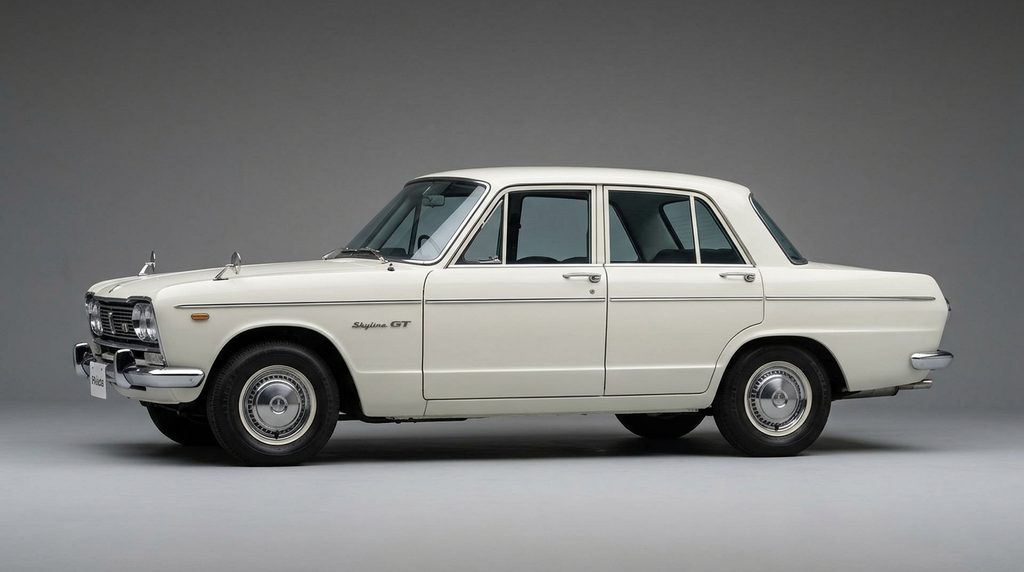
Prince Skyline GT (S54) & The Porsche Battle (1964)
The GT-R lineage traces its roots back to 1964. The Prince Motor Company lengthened the front end of their modest 4-door Skyline sedan to squeeze in a 2.0-liter straight-six engine. At the 1964 Japanese Grand Prix, the Prince Skyline GT briefly overtook a mid-engined Porsche 904 GTS. While the Porsche ultimately won, the display established the Skyline as a performance force. Prince merged with Nissan shortly thereafter in 1966.
1st Generation: PGC10 / KPGC10 “Hakosuka” (1969–1972)
- Engine: 2.0L naturally aspirated Inline-6 (S20)
- Power: ~160 hp @ 7,000 rpm
- Drivetrain: Front-engine, Rear-Wheel Drive (5-speed manual)
Debuting at the late 1968 Tokyo Motor Show as a sedan (PGC10) before launching in 1969, the first official Skyline GT-R featured the race-derived 24-valve DOHC S20 engine from the Prince R380 race car. A two-door coupe (KPGC10) followed in 1971. Nicknamed “Hakosuka” (combining the Japanese words for “Box” and “Skyline”), it dominated domestic Japanese touring car racing, securing dozens of consecutive race victories.
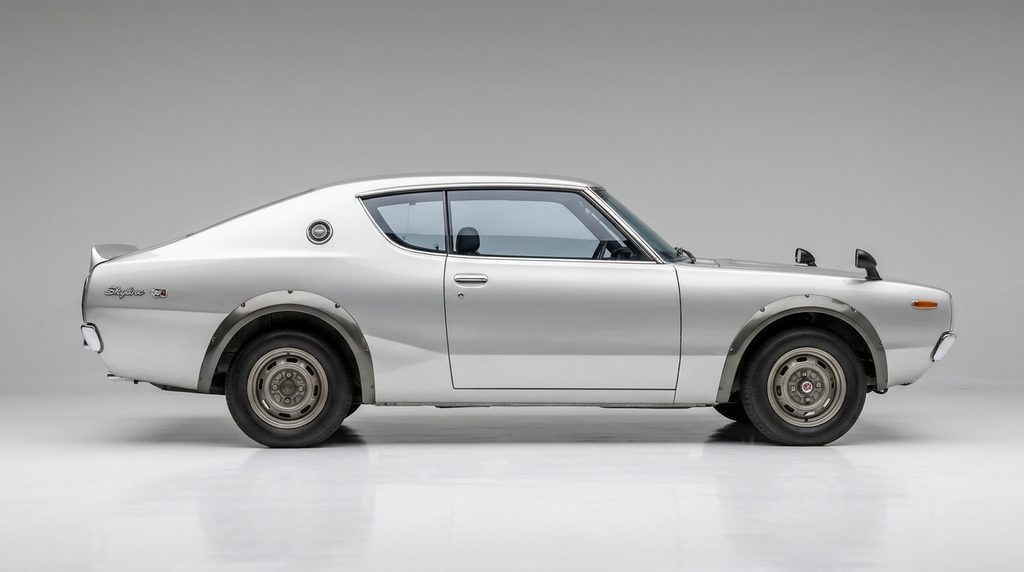
2nd Generation: KPGC110 “Kenmeri” (1973)
- Engine: 2.0L naturally aspirated Inline-6 (S20)
- Power: ~160 hp
Unveiled for the 1973 model year, the KPGC110 featured a fastback body style. It was nicknamed “Kenmeri” after a popular television ad campaign featuring a couple named Ken and Mary. However, strict emissions regulations and the global 1973 oil crisis led Nissan to pull out of motorsport and end production after just 197 units. The GT-R badge was shelved for 16 years.
2. The Golden Era: Revival & The “Godzilla” Years (1989–2002)
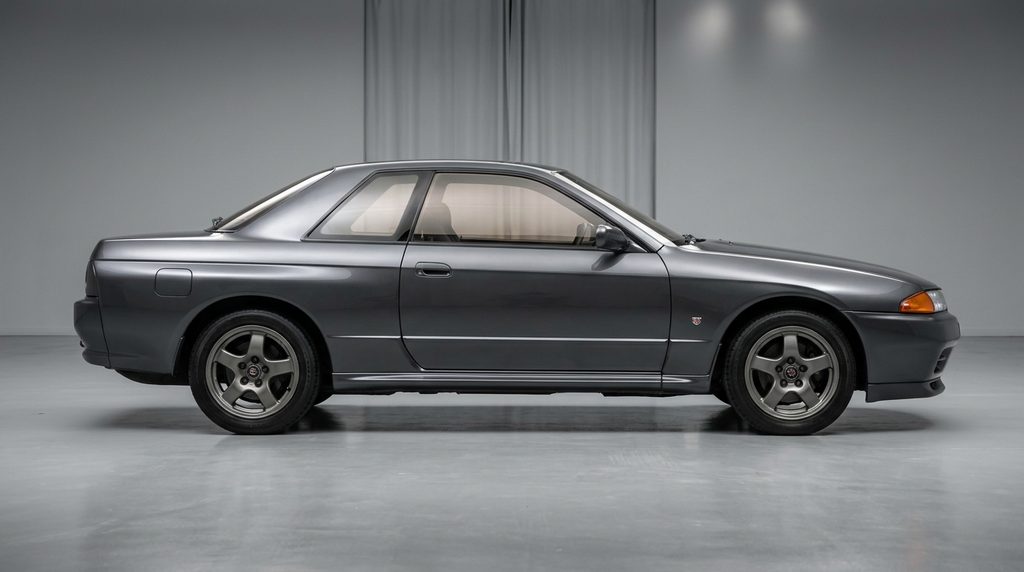
3rd Generation: R32 GT-R (1989–1994)
- Engine: 2.6L Twin-Turbocharged Inline-6 (RB26DETT)
- Power: 276 hp (Official Japanese “Gentlemen’s Agreement” rating; actual output was higher)
- Drivetrain: ATTESA E-TS All-Wheel Drive, 5-speed manual
In 1989, Nissan revived the GT-R badge specifically to dominate Group A touring car racing. Built around the twin-turbocharged RB26DETT engine and the ATTESA E-TS electro-hydraulic all-wheel-drive system (paired with Super-HICAS four-wheel steering), the R32 was a technological tour de force.
The car proved invincible:
- Won all 29 races it entered in the Japanese Touring Car Championship (JTCC).
- Dominated Australian Group A racing, prompting the local press to nickname it “Godzilla”—a monster from Japan that crushed everything in its path.
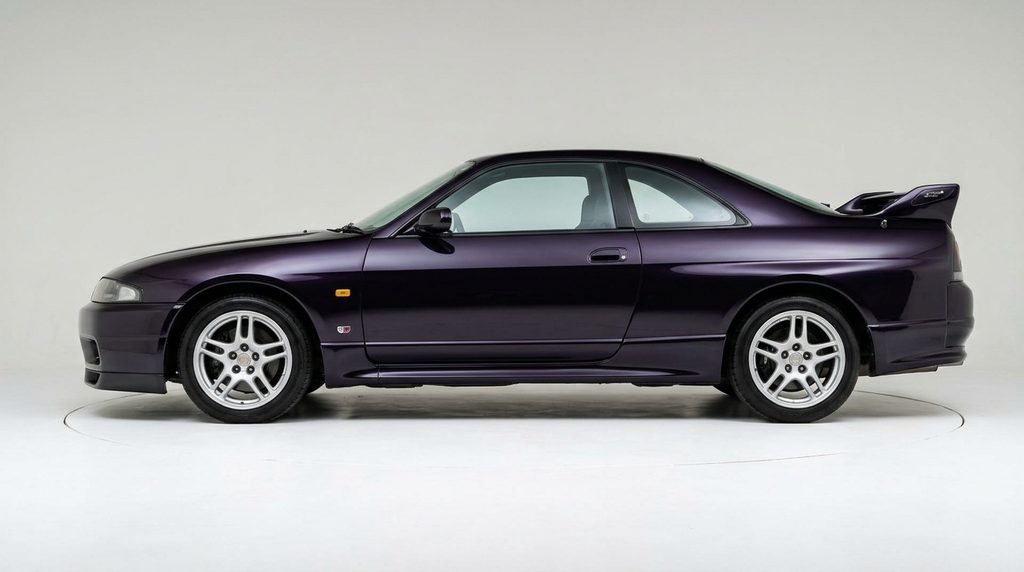
4th Generation: R33 GT-R (1995–1998)
- Engine: 2.6L Twin-Turbocharged Inline-6 (RB26DETT)
- Power: 276 hp (Official)
- Drivetrain: ATTESA E-TS Pro AWD, 5-speed manual
Launched in January 1995, the R33 GT-R featured a longer, stiffer chassis, improved aerodynamics, refined suspension, and an updated ATTESA E-TS Pro system with an active rear differential. It became the first production car to turn a sub-8-minute lap around the Nürburgring Nordschleife. This era also spawned the ultra-exclusive NISMO 400R, which delivered 400 hp from an enlarged 2.8L RB-X GT2 engine.
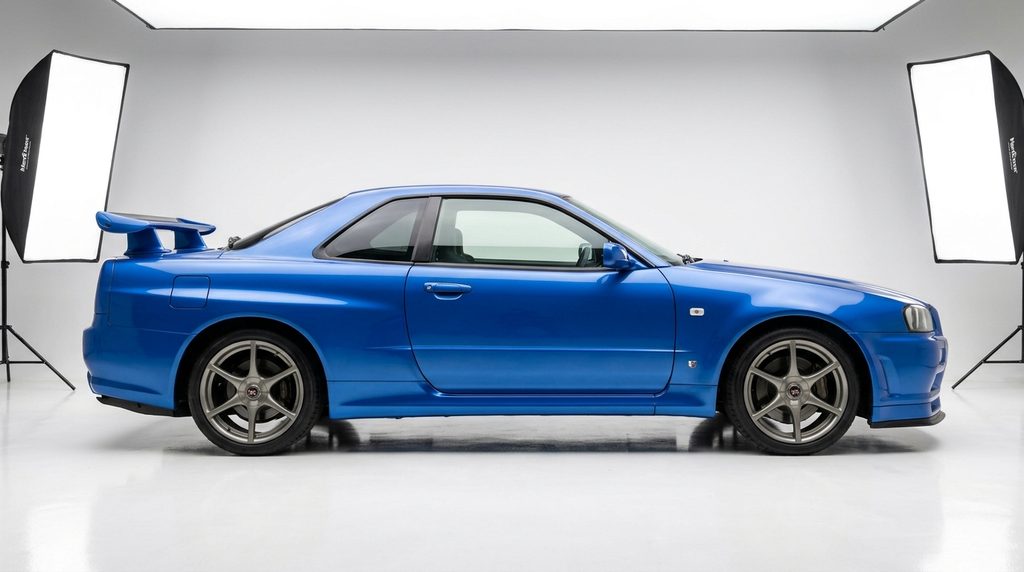
5th Generation: R34 GT-R (1999–2002)
- Engine: 2.6L Twin-Turbocharged Inline-6 (RB26DETT)
- Power: 276 hp (Official; actual ~320+ hp)
- Drivetrain: ATTESA E-TS Pro AWD, 6-speed Getrag manual
The R34 GT-R shortened the wheelbase relative to the R33, featuring aggressive, boxy styling reminiscent of the R32. Innovations included twin ball-bearing turbochargers and a dashboard 5.8-inch MFD (Multi-Function Display) providing real-time telemetry like boost pressure, G-forces, and oil temperatures.
Key variants included the V-Spec, V-Spec II, M-Spec, and the legendary NISMO Z-Tune—a hand-built 500-hp swansong for the RB26 platform. Popularised globally by racing video games (Gran Turismo) and cinema (The Fast and the Furious), the R34 solidified the GT-R’s status as a global automotive cultural icon.
3. The Modern Era: Independent Supercar (2007–Present)
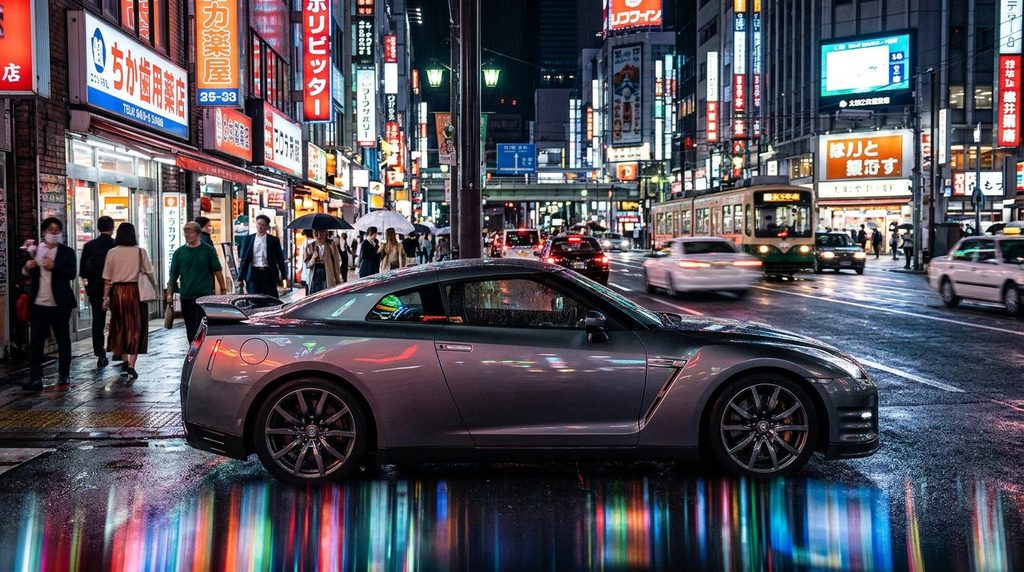
6th Generation: R35 GT-R (2007–Present)
- Engine: 3.8L Twin-Turbocharged V6 (VR38DETT)
- Power: 480 hp at launch; scaled up to 565–600 hp (NISMO variants) in later iterations
- Drivetrain: ATTESA E-TS AWD, 6-speed dual-clutch rear transaxle
Unveiled at the 2007 Tokyo Motor Show, the R35 dropped the “Skyline” nameplate to become an independent, global supercar platform. Moving away from the inline-six, it adopted a hand-built VR38DETT V6 assembled by master technicians known as Takumi. With launch control, a rapid dual-clutch transmission, and computer-controlled all-wheel drive, the R35 achieved 0–60 mph times under 3 seconds, punching far above its price tag against exotic European supercars.
Technical Lineage Overview
| Generation | Platform | Production Years | Engine Code | Layout / Drivetrain |
| 1st Gen | PGC10 / KPGC10 | 1969–1972 | 2.0L S20 I6 | FR (Rear-Wheel Drive) |
| 2nd Gen | KPGC110 | 1973 | 2.0L S20 I6 | FR (Rear-Wheel Drive) |
| 3rd Gen | R32 | 1989–1994 | 2.6L RB26DETT Twin-Turbo I6 | ATTESA E-TS AWD |
| 4th Gen | R33 | 1995–1998 | 2.6L RB26DETT Twin-Turbo I6 | ATTESA E-TS Pro AWD |
| 5th Gen | R34 | 1999–2002 | 2.6L RB26DETT Twin-Turbo I6 | ATTESA E-TS Pro AWD |
| 6th Gen | R35 (GT-R) | 2007–Present | 3.8L VR38DETT Twin-Turbo V6 | Transaxle ATTESA E-TS AWD |