Technical Deep-Dive: Aerodynamics, Design, and Engineering of the F1 Car Rear Wing
The rear wing is one of the most critical aerodynamic components on a Formula 1 car, generating roughly 30% to 35% of total downforce while directly impacting top-speed capability and overtaking potential. Positioned at the back of the chassis, it balances front-axle dynamic loads and acts as a powerful pump that pulls airflow through the floor and rear diffuser.
1. Core Functions of the F1 Rear Wing
The F1 rear wing performs three primary fluid-dynamic functions:
- Rear Downforce Generation: Creating heavy vertical load ($F_z$) on the rear axle to maximise cornering grip and traction under acceleration.
- Diffuser Extraction (Pumping Effect): Creating a low-pressure wake behind the car that helps extract air from under the floor, drastically increasing underbody downforce.
- Drag Adjustment via DRS: Utilising movable flap systems to shed aerodynamic drag ($F_d$) on straightaways to facilitate high overtaking speeds.
2. Fundamental Aerodynamic Principles
  [ Clean High-Level Air ] ---> [ Mainplane & Top Flap ] ---> [ Rear Axle Downforce ]
                                           |
                                           v
  [ Low-Pressure Wake ]   ---> [ Diffuser Extraction ] ---> [ Floor Venturi Downforce ]
                                           |
                                           v
  [ DRS Actuation ]       ---> [ Flap Slot Gap Opens ] ---> [ Reduced Straightaway Drag ]
Downforce Generation and Dynamic Pressure
Like the front wing, the rear wing functions as an inverted multi-element airfoil. As airflow strikes the mainplane and upper flap, it splits into high-pressure air moving over the top surface and high-velocity, low-pressure air accelerated underneath.
According to Bernoulli’s equation for steady, incompressible flow:
$$P_1 + \frac{1}{2}\rho v_1^2 = P_2 + \frac{1}{2}\rho v_2^2$$
Where:
- $P$ = Static pressure
- $\rho$ = Air density
- $v$ = Local airflow velocity
The dynamic pressure difference between the upper and lower surfaces creates a downward force ($F_z$), defined by:
$$F_z = \frac{1}{2} C_L \rho A v^2$$
Where $C_L$ is the negative lift coefficient, $A$ is the wing planform area, and $v$ is the freestream velocity.
Upwash and Diffuser Coupling
The rear wing does not operate in isolation. The intense upward trajectory of air leaving the trailing edge of the rear wing flap creates a strong low-pressure zone directly underneath and behind the wing. This low-pressure volume accelerates flow out of the underlying diffuser (the beam wing and floor exit), pulling massive amounts of ground-effect air through the car’s underbody.

3. Structural Anatomy & Key Components
Modern F1 rear wings consist of interconnected carbon-fibre composite elements engineered to survive extreme pressure loads without structural failure:
| Component | Function | Engineering Mechanics |
| Mainplane | Primary lower fixed wing element | Shapes the baseline lower pressure field and directs flow upward into the trailing flap. |
| Upper Flap (DRS Flap) | Secondary adjustable top element | Rotates via hydraulic or electronic actuators to alter drag and downforce profiles. |
| Endplates | Pressure boundary & tip-vortex management | Prevents high-pressure air on top from spilling into the low-pressure underside. |
| Beam Wing | Lower auxiliary wing element | Connects floor diffuser flow to the primary rear wing structures, amplifying underbody downforce. |
| DRS Actuator Pod | Hydraulic or electromechanical linkage | Opens the upper flap up to 85 mm during DRS activation within strict timing windows. |
4. Drag Reduction System (DRS), Mechanics
Introduced to aid overtaking, the Drag Reduction System (DRS) is a driver-activated hydraulic/mechanical mechanism that changes the rear wing’s geometry in real time.
  [ Standard Mode (DRS Closed) ]        [ DRS Active (Flap Opened) ]

     /----------------/                   /----------------/  (Upper Flap)
    /   High Downforce /                 / Reduced Angle  /
   /__________________/                 /________________/
          |                                   === 85mm Gap ===
   /------------------/                 /------------------/  (Mainplane)
  /__________________/                 /__________________/
- DRS Closed: The slot gap between the mainplane and upper flap remains tight (typically 10–15 mm). Flow stays attached over both high-camber elements, generating maximum downforce and high drag.
- DRS Open: The actuator rotates the upper flap, opening a gap up to 85 mm. Flow breaks off or bypasses the upper element, dramatically reducing profile drag and adding up to 10–12 km/h in top speed on straightaways.
5. Structural Engineering & Aeroelasticity
Rear wings must endure vertical downforce loads exceeding 6,000 N (over 600 kg of force) at speeds above 300 km/h. They are built using high-modulus pre-preg carbon fibre composite layups cured in high-pressure autoclaves to maintain extreme stiffness while minimising overall chassis mass.
Aeroelastic Tailoring and Deflection Limits
Formula 1 teams engineer subtle aeroelastic properties into the rear wing structure:
- Passive Drag Reduction: At peak straightaway speeds, dynamic pressure pushes the wing elements backwards or down, slightly reducing the slot gap or flap angle to shed drag without activating DRS.
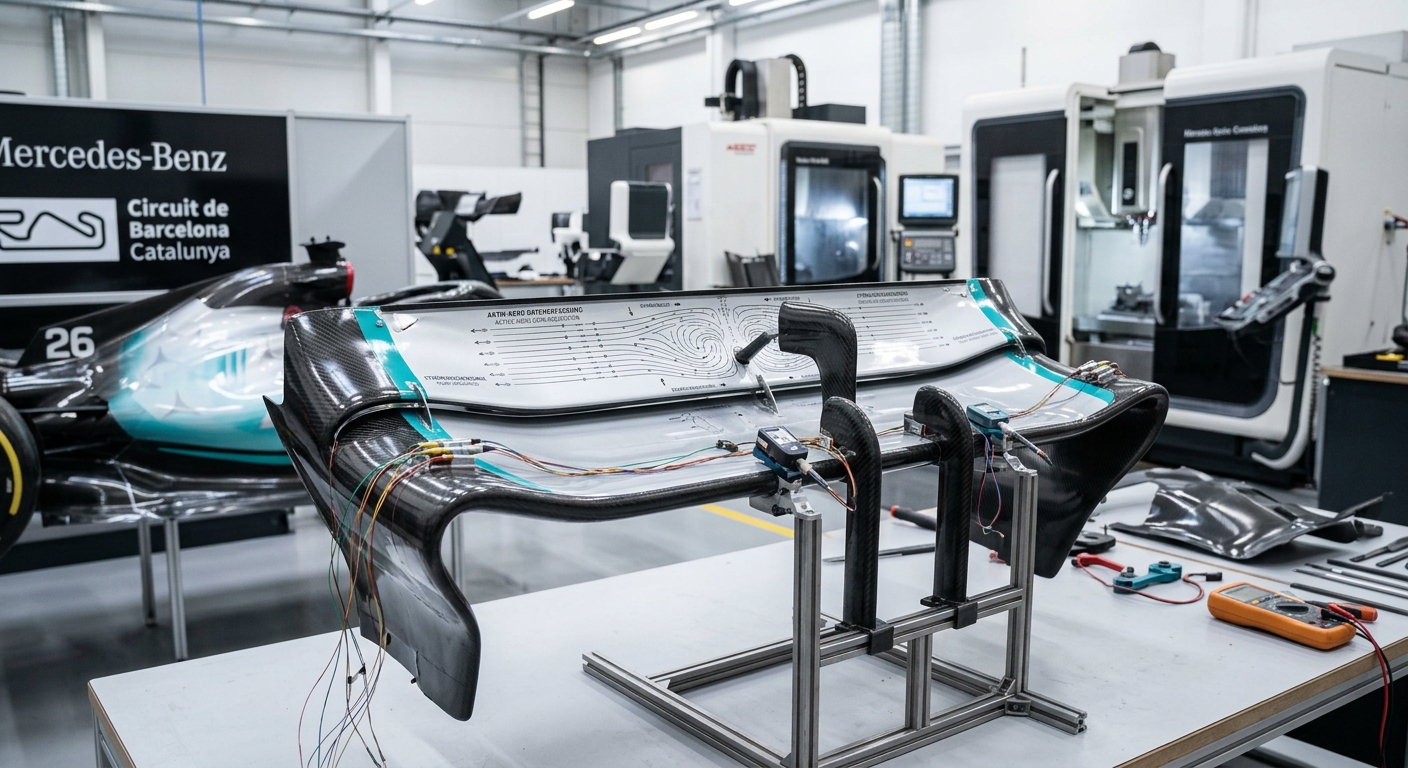
- Regulatory Compliance: The FIA enforces strict static load and deflection tests—applying specified weights to the wing tips, centerlines, and endplates—to ensure flexible rear wings stay within regulatory tolerances.
6. Engineering Trade-Offs in Rear Wing Setup
Setting up an F1 rear wing requires balancing specific track requirements:
- High-Downforce Configurations (e.g., Monaco, Hungaroring): Feature steep wing camber angles, aggressive gurney flaps, and multi-element beam wings to maximise cornering grip at the expense of high drag.
- Low-Downforce Configurations (e.g., Monza, Spa): Utilise flat, shallow-camber mainplanes (“spoon” or low-drag wings) to minimise straightaway drag and maximise top speed.
- Structural Weight vs. Deflection Risk: Lightening wing assemblies saves weight above the car’s centre of gravity, but increases the risk of component flexing and failing FIA static deflection checks.