The F1 Wear Plank: Technical Overview, History, and Engineering Mechanics
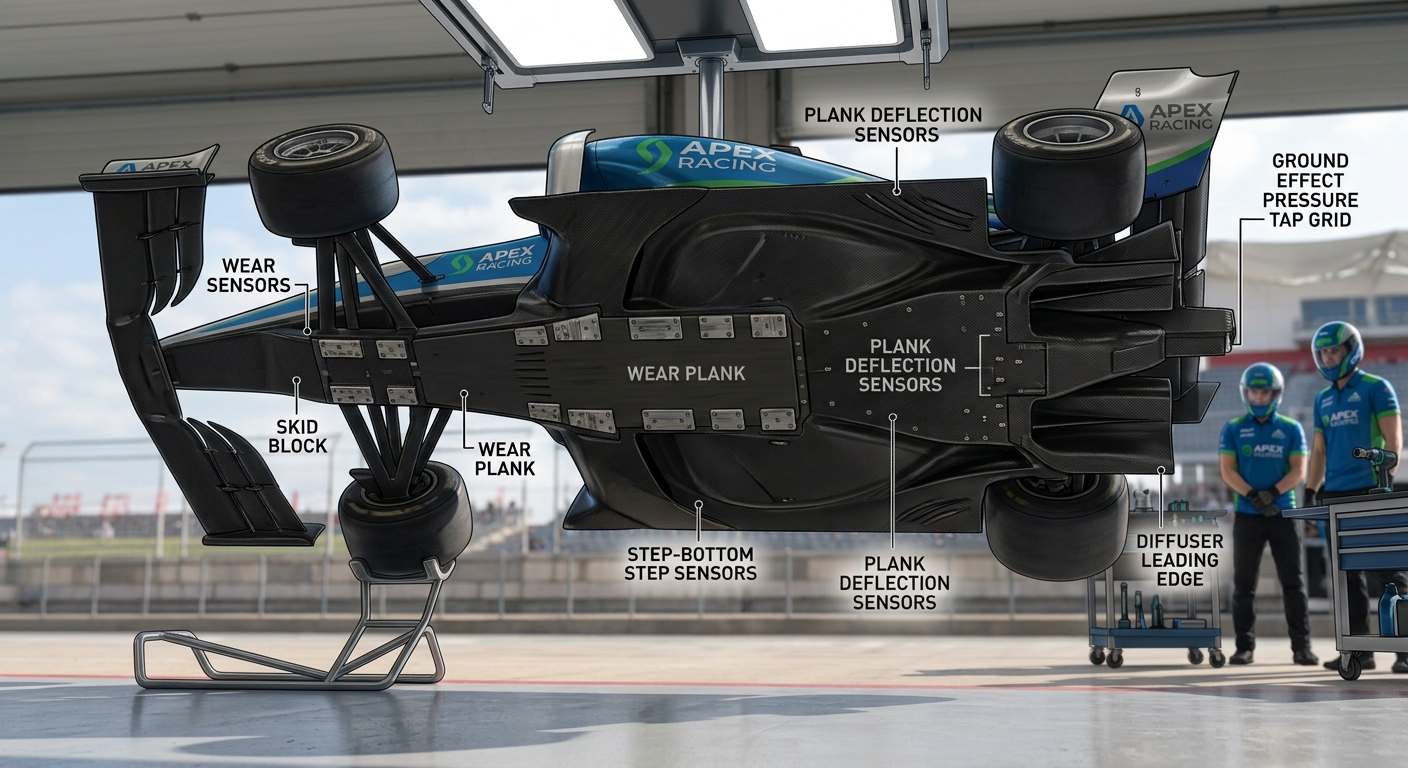
The wear plank (also known as the skid block or underbody plank) is a mandatory, standardised component mounted underneath every Formula 1 car. Extending across the flat central floor of the chassis, this seemingly simple component plays a vital role in enforcing minimum ride height regulations, limiting cornering speeds, and ensuring safety parity across the grid.
1. History and Background
The FIA introduced the underbody plank midway through the 1994 Formula 1 season as part of a sweeping package of safety measures following the tragic fatal accidents at Imola.
  [ Pre-1994 Ultra-Low Floor ] ---> Extreme Ground-Effect Downforce
                                                  |
                                                  v
                                     Bottoming Out On Track
                                                  |
                                                  v
                                     Sudden Aerodynamic Stall
                                                  |
                                                  v
  [ Post-1994 Wear Plank ]     ---> Enforces Minimum Ride Height
Before its introduction, teams ran cars as low to the ground as physically possible to maximise ground-effect downforce. However, if a car bottomed out over a bump or kerb, air under the floor was completely choked off, leading to a sudden, catastrophic loss of downforce and control. The plank was implemented to physically penalise any team running their chassis dangerously low.
2. Materials and Construction
Although often referred to historically as “wood,” modern F1 planks are advanced, highly engineered composite materials:
- Permaglass: A light, dense, non-flammable glass-reinforced plastic laminate (composite) widely used in modern F1 applications due to its uniform density and predictable wear characteristics.
- Jabroc (Historical & Lower Formulas): A composite material made from laminated beechwood veneers pressurised and impregnated with synthetic resin. While used extensively in earlier eras of F1 (and still used in Formula 2 and Formula 3), F1 shifted toward glass-based composites.
- Titanium Skid Plates: Small titanium inserts embedded flush into the composite plank around specified FIA measurement points. These hard metal plates protect the composite material from excessive abrasion and generate the signature showers of sparks seen when cars strike the asphalt at high speed.

3. Regulatory Standards and Dimensions
The FIA Technical Regulations define the dimensions, mounting placement, and permissible wear tolerances of the plank assembly:
| Specification Parameter | FIA Requirement |
| New Plank Thickness | 10.0 mm ($\pm 0.2\text{ mm}$) |
| Plank Width | 300 mm ($\pm 2\text{ mm}$) |
| Longitudinal Coverage | Extends from 330 mm behind the front wheel centerline to the rear wheel centerline |
| Material Homogeneity | Must consist of uniform material density throughout its structure |
| Legality Check Method | Measured with micrometre callipers at designated holes along the plank’s length |
Wear Tolerances & Parc Fermé Checks
To ensure compliance, FIA technical delegate officials measure the plank’s thickness after every session. If a car wears the plank beyond the allowable limit around the designated inspection holes, the violation results in an immediate disqualification from the session or race results.
4. Engineering Trade-Offs & Setup Dynamics
Engineering an F1 car’s setup requires balancing the performance gain of a low ride height against the risk of excessive plank wear:
- Aerodynamic Efficiency vs. Wear Risk: Running lower ride heights lowers the floor’s Venturi tunnels, drastically increasing underbody downforce ($F_z$) and cornering speeds. However, running too low risks scraping the plank away on bumpy circuits or heavy-fuel stints.
- Fuel Load & Suspension Stiffness: At the start of a Grand Prix, a full fuel load adds over 100 kg of mass, compressing the suspension closer to the tarmac. Teams must stiffen vertical spring rates or raise static ride height to account for full-tank compression.
- Kerb Aggression: Striking curb edges too aggressively can chip or gouge the plank composite, leading to targeted wear points that exceed local measurement tolerances during post-race scrutineering.