
Technical Deep-Dive: Aerodynamics, Design, and Engineering of the F1 Car Front Wing
The front wing is arguably the most critical aerodynamic deliverable on a modern Formula 1 car. Operating in clean, undisturbed ambient air, the front wing generates roughly 25% to 30% of the vehicle’s total downforce. More importantly, it conditions and directs the entire airflow structure over, under, and around the car, dictating the operational efficiency of the floor, sidepods, diffuser, and rear wing.
1. Core Functions of the F1 Front Wing
The F1 front wing serves three primary fluid-dynamic functions:
- Downforce Generation: Generating direct front-axle downforce to balance the car’s dynamic center of pressure ($CoP$) relative to its centre of gravity ($CoG$).
- Flow Conditioning: Preparing uniform, high-energy airflow for the leading edge of the floor, Venturi tunnels, and sidepod radiator inlets.
- Outwash Management: Managing the high-drag turbulent wake generated by the rotating front tires, pushing high-pressure turbulence away from the underbody.
2. Fundamental Aerodynamic Principles
  [ Ambient Air ] ---> [ Mainplane Flaps ] ---> [ Downforce Generation ]
                             |
                             v
                    [ Outwash Generation ] ---> [ Pushes Tire Wake Away ]
                             |
                             v
                    [ Vortex Formation ]   ---> [ Seals Venturi Floor Edge ]
Downforce and Bernoulli’s Principle
The wing profile operates as an inverted airfoil. Air flowing underneath the wing must travel faster than air over the top. According to Bernoulli’s Principle:
$$P + \frac{1}{2}\rho v^2 = \text{Constant}$$
Where:
- $P$ = Static pressure
- $\rho$ = Air density
- $v$ = Flow velocity
The velocity differential ($\Delta v$) creates a low-pressure area underneath the mainplane and high pressure above it, generating a net downward force ($F_z$):
$$F_z = \frac{1}{2} C_L \rho A v^2$$
Where $C_L$ is the coefficient of lift (negative for downforce) and $A$ is the reference surface area.
Ground Effect Interaction
Because the front wing operates in close proximity to the track surface ($h/c < 0.5$, where $h$ is ground clearance and $c$ is chord length), it experiences enhanced efficiency known as ground effect. The proximity of the tarmac constrains the expansion of the air under the wing, increasing local flow velocity and lowering static pressure significantly beyond isolated open-air wing behaviour.

3. Structural Anatomy & Key Components
Modern F1 front wings consist of several highly integrated carbon-fibre composites and metallic elements regulated strictly by the FIA:
| Component | Function | Engineering Mechanics |
| Nose Structure | Structural crash structure & central mounting | Transfers front aerodynamic loads directly into the monocoque/chassis. |
| Mainplane | Primary lower aerodynamic element | Operates closest to the ground; initiates downforce generation and ground effect expansion. |
| Flaps (Upper Elements) | Secondary downforce adjustments | Features variable Angle of Attack (AoA) setups to trim front-end aero balance during track sessions. |
| Endplates | Outwash control & vortex management | Blocks high-pressure air on top from spilling into low-pressure air beneath, reducing induced drag. |
| Diveplanes (Canards) | Outwash assist & local vortex generator | Mounted externally on the endplate to pull air upward and outward, lifting front wheel wake. |
4. Modern Technical Regulations & Outwash Mitigation
The Outwash Challenge
Front tyres are aerodynamically inefficient, generating massive drag and complex turbulent structures known as tyre wake. Historically, teams utilised intricate multi-element wing assemblies, cascade wings, and turning vanes to blast air outward (outwash), bypassing the front tyre and preventing wake from entering the floor.
The 2022–2026 Regulatory Shift
To facilitate closer racing and reduce dirty air (upwash turbulence that degrades the trailing car’s aerodynamic balance), the FIA introduced sweeping technical regulations in 2022 designed to limit extreme outwash:
- Swept Mainplanes: Flaps must connect directly to the endplate and central nose section without sharp, open edges that produce strong free vortices (such as the historical Y250 vortex).
- Simplified Endplates: Intricate winglets and multi-element cascades were banned, forcing teams toward rolled endplate geometries.
- Controlled Downwash/Outwash: The aerodynamic profile was standardised to force wake inward and upward over trailing cars rather than expanding wide across the track.
Despite these restrictions, aerodynamicists utilise subtle slot gaps, variable flap camber, and legal endplate curvature to generate localised vortices that seal the ground-effect floor edges further downstream.
5. Structural Engineering and Aeroelasticity
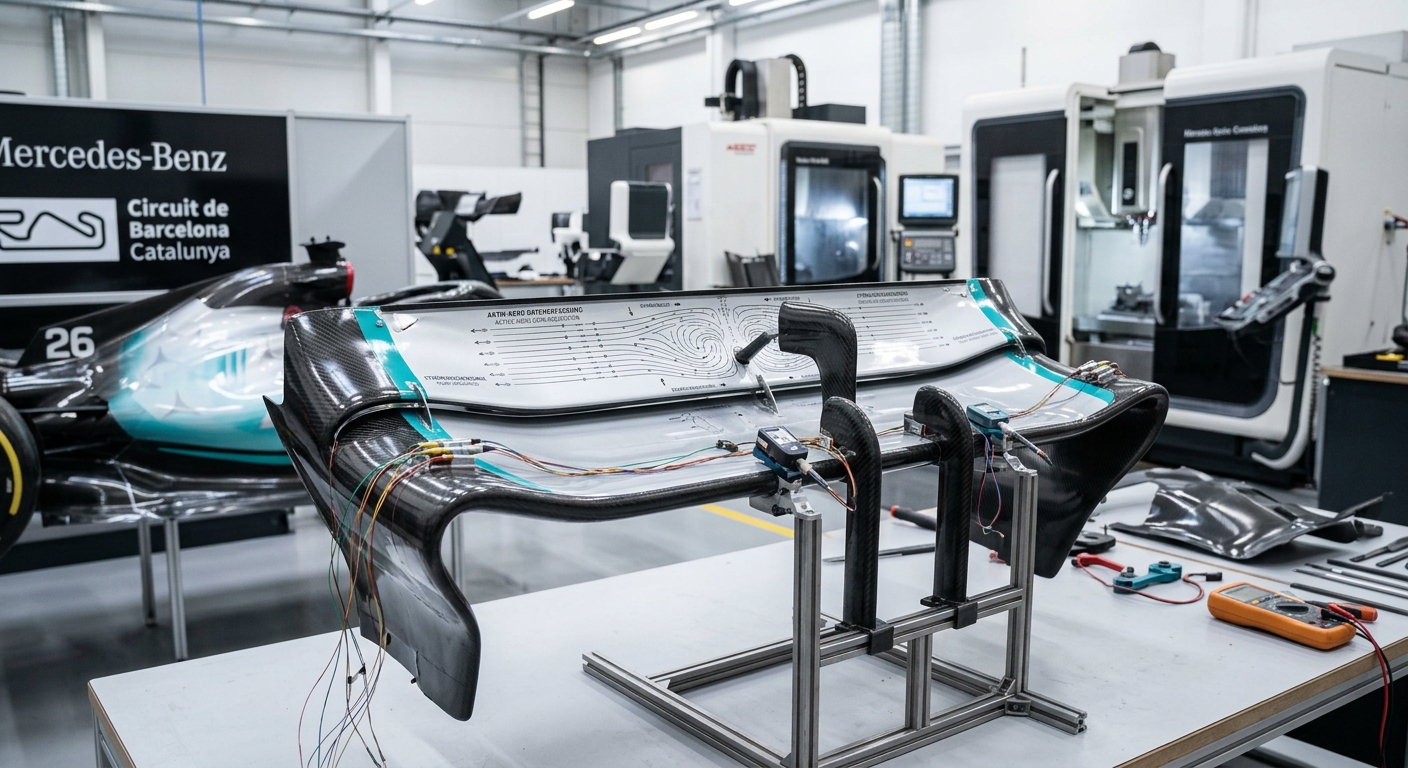
Front wings must withstand extreme vertical loads exceeding 3,000 to 4,000 N at peak track speeds without structural failure, while remaining as light as possible (fabricated primarily from pre-preg carbon fibre composites cured in autoclaves).
Aeroelastic Tailoring (Flexi-Wings)
Teams engineer the anisotropic properties of carbon fibre layups to achieve controlled structural deformation under high aerodynamic loads:
- High-Speed Straightaways: High drag ($F_d$) and downforce ($F_z$) push the wing elements downward or flex flap tips open. This reduces the effective Angle of Attack, shedding unwanted drag and boosting top speed.
- Low-Speed Corners: Lower dynamic pressure causes the wing to return to its un-flexed, high-camber profile, maximising downforce when cornering grip is needed.
The FIA rigorously tests structural stiffness using static load tests (applying mass weights at specified points) to ensure flexure remains within strict compliance limits.
6. Summary of Engineering Trade-Offs
Designers continuously balance competing aerodynamic priorities:
- Downforce vs. Drag: Adding flap angle increases front grip but linearly escalates profile drag.
- Front-End Grip vs. Downstream Stability: Maximising local wing downforce can destabilise airflow heading toward the floor edges and rear diffuser.
- Stiffness vs. Weight: Making the wing completely rigid adds mass, whereas optimising layups for aeroelastic flexibility risks failing FIA deflection checks.